Last month, I wrote about the importance of having a village around us: people who support our healing, nourish our relationships, and help us feel less alone. This month, I want to stay with that theme, but turn towards our own part in it. Because while we cannot create a healthy village on our own, and we certainly cannot make other people safe, kind, available, or emotionally mature, we can begin to notice what we are carrying from our side. We can notice what we bring into the atmosphere around us.
The people in our village are not only “out there.” Once we are in relationship with them, they also live inside us. They live in our nervous systems as memories, expectations, disappointments, loyalties, resentments, tenderness, gratitude, grief, longing, irritation, fear, and love. And, what we carry about them does not stay neatly tucked away inside us.
It affects our body.
It affects our mood.
It affects our tone of voice.
It affects how open or defended we feel.
It affects what we bring home to our partner, our children, our friendships, our work, and our wider life.
This is not about blaming ourselves. It is not about making ourselves responsible for everyone else’s behaviour, or for the whole relational field. We cannot clear someone else’s resentment. We cannot soften someone else’s defensiveness. We cannot do another person’s healing for them.
But we can tend our own side.
We can notice when our mind keeps going to a story.
We can notice where resentment has hardened in us.
We can notice when our thoughts are less than kind and compassionate.
We can notice where goodwill has run dry.
And this matters. Because the atmosphere around a relationship is not only created by what happens between two people. It is also shaped by what each person is carrying into the space.
If I have spent the day rehearsing an argument in my mind, criticising someone inwardly, bracing against imagined judgment, or nursing old hurt, my partner may not know the details — but they may sense something is off.
They may feel my guardedness, irritability or vulnerability.
They may sense me keeping my distance.
They may know that I am not fully available, but won’t know why – and, they might not ask.
And, of course, the same is true in reverse. We are always affecting one another, often in so many more ways than we realise. This is why nervous system healing is not only personal. It is relational. When we practise calming, softening, releasing, forgiving, appreciating, or offering kindness, we are not just changing an inner state. We are changing what we bring into relationship. We are tending the relational field, and clearing the air in our part of the village.
Here are four gentle practices that can help.
Gratitude: remembering the good
Gratitude is not about pretending everything is fine.
It is not about denying pain, disappointment, loneliness, or unmet needs.
It is simply the practice of turning towards what is also true.
Who has helped you?
Who has shown you kindness?
Who has stood beside you, even imperfectly?
Who has made your life a little easier, warmer, safer, or more beautiful?
The nervous system is designed to scan for threat. This is not a character flaw. It is part of how we survive. But when we have lived through stress, trauma, conflict, or emotional insecurity, this threat-scanning can become overdeveloped through hypervigilance. We notice what is missing and what is present more easily than others, such as micro-aggressions. We may remember who hurt us more easily than who helped us.
A gratitude practice gently interrupts this.
You might bring to mind one person who has supported you in some way. Not necessarily dramatically. Perhaps someone sent a kind message or listened to you, or made you laugh on a difficult day. Perhaps someone simply reached out when you felt all alone and they didn’t even know what that meant to you.
Then notice what happens in your body as you remember them.
Is there warmth?
Softening?
A fuller breath?
A sense of being less alone?
This is not just a nice thought. It is a nervous system experience.
Gratitude helps us remember that support exists.
And when we remember support, we may become more available to receive it.
Forgiveness: loosening what we are still carrying
Forgiveness is delicate territory.
It should never be used to excuse harm, bypass pain, rush grief, or pressure someone into reconciliation. Forgiveness does not mean pretending something did not matter. It does not mean abandoning ourselves or trashing our boundaries. It does not mean giving unsafe people renewed access to us.
But sometimes, long after something has happened, and we are still carrying the injury in our own body, and playing out the details in our minds, practicing forgiveness can help: help us, that is, not them. They won’t even know that we are forgiving what they did, and they might not even know that they did anything, or often, they consider themselves to be the victims in the story, as they’ll have their own version of events.
We replay the conversation.
We rehearse what we wish we had said.
We tighten when we think of them.
We keep drinking from the cup of resentment, even when the other person may have moved on, forgotten, or remained completely unaware of what we are carrying.
Forgiveness, in this sense, is not something we do for them, then, it is something we explore for ourselves, when we are ready.
It might begin very simply:
“This hurt me.”
“I am still carrying this.”
“I do not have to minimise what happened.”
“And I am willing to loosen one small part of the grip this has on my body.”
That may be enough.
We do not have to force forgiveness. We do not have to leap into spiritual generosity before the body is ready. Sometimes the first honest step is simply acknowledging the hurt without letting it poison everything. Forgiveness, when it is real, can help clear the air from our side. Not because the other person has necessarily changed, but because we are no longer willing to let the old injury keep shaping our present atmosphere.
Loving-kindness: practising goodwill
Loving-kindness is the practice of cultivating goodwill towards ourselves and others.
Again, this is not about forcing ourselves to feel loving towards people we are not ready to include. It is not about overriding anger or pretending we are more open-hearted than we are.
It is a practice, and like all practices, we begin where there is least resistance.
Find yourself a healing space such as in nature or somewhere safe and comfortable. Begin with offering loving kindness to yourself – repeating for as long as it feels nourishing to you. Silently, or speaking out loud these simple phrases:
May I be well.
May I be kind to myself.
May I be safe from harm.
May I be peaceful and at ease.
Then, if it feels right, you might offer loving kindness to someone easy to love. This could be a friend, mentor, teacher or spiritual guide, or a child, or a pet. You can repeat these phrases as many times as you like:
May you be well.
May you be kind to myself.
May you be safe from harm.
May you be peaceful and at ease.
Then, if it feels okay to you, see if you might like to imagine someone who has been a source of difficulty for you. As you imagine this person, notice how you feel in your body and what emotions are arising for you. If the feelings are overwhelming you might like to return to offering loving kindness to yourself to help develop compassion for your pain. If you would like to try the practice with the difficult person, begin to visualise them and imagine that you can choose how close or far away you would like them to be. Then, gently explore offering them the words:
May you be well.
May you be kind to myself.
May you be safe from harm.
May you be peaceful and at ease.
As long as it feels okay to you, repeat until it feels complete. Then, see the image of that person gently fading away as you bring your attention back to your healing space. Take the time to celebrate yourself for engaging in a difficult practice that took courage.
Lastly, come back to yourself to end the practice – saying the words again:
May I be well.
May I be kind to myself.
May I be safe from harm.
May I be peaceful and at ease.
The words offer a kind of magical healing, as they soothe the nervous system and make us feel better about ourselves and others – promoting empathy, compassion, love and peace.
Instead of rehearsing irritation, blame, fear, or separation, we are gently practising goodwill.
This does not mean we will always feel it.
It does not mean that relationships are easy.
It does not mean boundaries are no longer needed.
But loving-kindness can begin to soften the atmosphere inside us. And when the atmosphere inside us softens, something around us often softens too.
Self-compassion: including ourselves in the circle of care
Self-compassion may be the foundation of all the others, because if we are harsh with ourselves, we often carry that harshness into the world. If we are constantly criticising ourselves, shaming ourselves, pushing ourselves, or telling ourselves we should be further along by now, our nervous system remains under threat, and a threatened nervous system finds it harder to connect. Self-compassion is not self-pity. It is not making excuses. It is not avoiding responsibility. Rather, it is the practice of meeting our own suffering with kindness.
A simple self-compassion practice might be:
This is hard.
I’m feeling overwhelmed, anxious, sad.. etc.
Now take a deep breath and see if you can love yourself just as you are. Without judgement, notice if you are able to receive this care from yourself. If you find it difficult to feel kindness towards yourself, see if you can imagine another person who loves you and treats you with kindness. Or it could be a pet or spiritually meaningful source of comfort to you. Notice how you feel as you imagine receiving care and kindness from this person, animal or entity.
That is all.
A hand on the heart.
A slower breath – a moment of recognition.
“This is hard.”
So much softens when we stop arguing with our own pain.
And when we stop attacking ourselves inside, we often become less defensive with others. We have less to prove. Less to protect. Less to fight.
We surrender, soften, and become open to receiving.
This, too, changes the atmosphere.
Clearing our side
None of these practices can fix another person.
They cannot make someone else kind.
They cannot make a family member emotionally mature.
They cannot make a partner do their own inner work.
They cannot transform an unsafe relationship into a safe one.
But they can help us become clearer.
They can help us notice what we are carrying.
They can help us soften where we are ready to soften.
They can help us stop adding unnecessary toxicity to the field.
They can help us bring more steadiness, warmth, honesty, and compassion into the spaces we inhabit.
We cannot clean the whole field.
We can clean our side of the field.
And that matters.
This is part of what we practise in my Yoga Therapy for Trauma Recovery groups. The work is based on Arielle Schwartz’s book and training of that name, which I am certified in and am currently doing the training again as I love it so much. I have been using it for my own trauma healing as well as in my practice, and am currently half way through my third 6-week course in my community. It is gentle and body-based, using breathwork, meditation, vagus nerve stimulation, mindful movement, and relational practices such as the loving-kindness, and self-compassion practices above that come from the book.
These are not just calming practices. They are ways of helping the nervous system experience safety again, and becoming more available to ourselves and to others. In addition to the aspect of the method that comes from polyvagal theory, I find that that the yogic philosophies and practices help to tend the atmosphere that we bring into our relationships, our homes, and our wider village.
Healing does not happen by trying to become perfect. It happens through small, repeated moments of awareness, honesty, kindness, and repair. It happens when we begin, gently and humbly, with our own side.
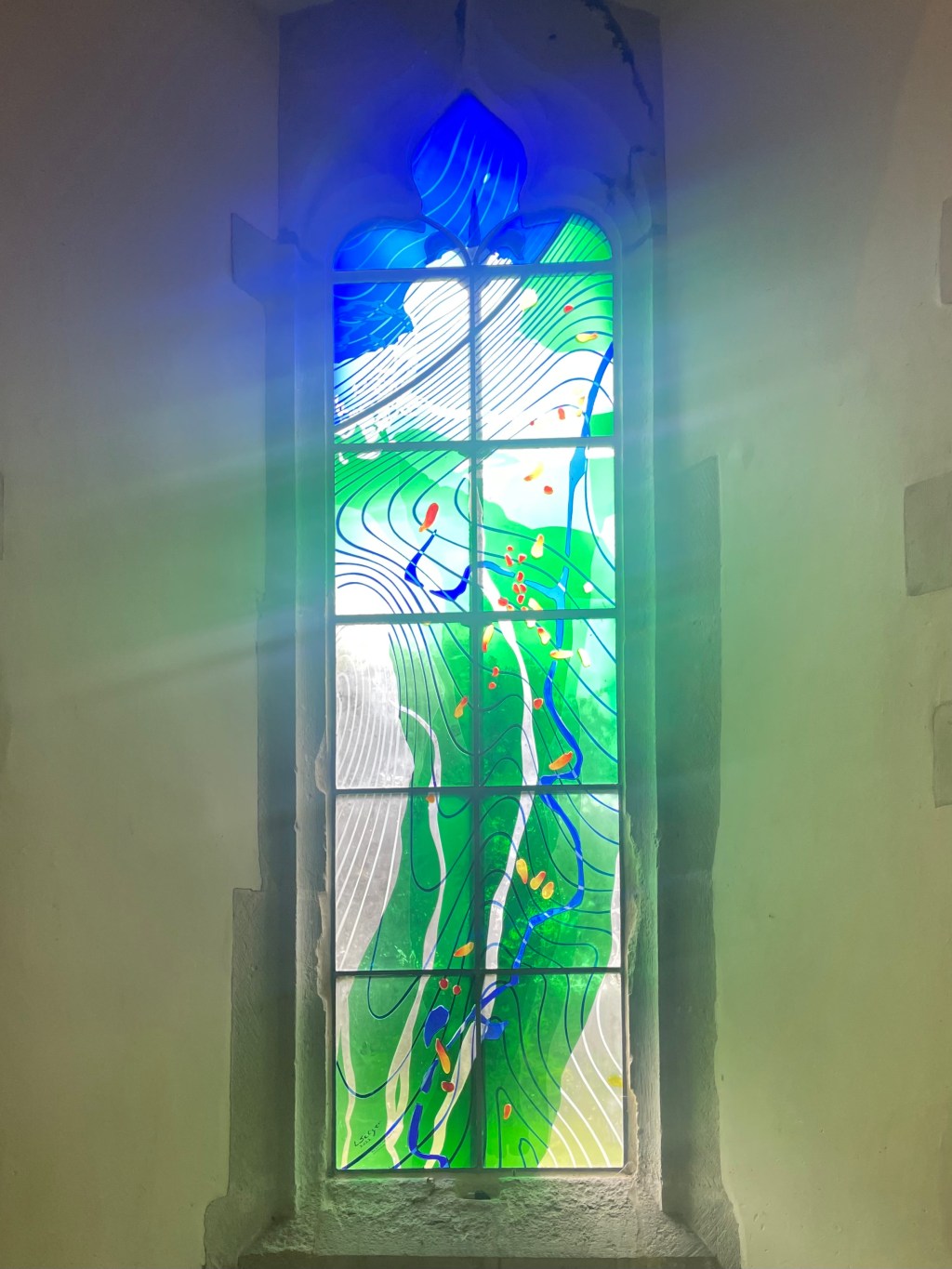
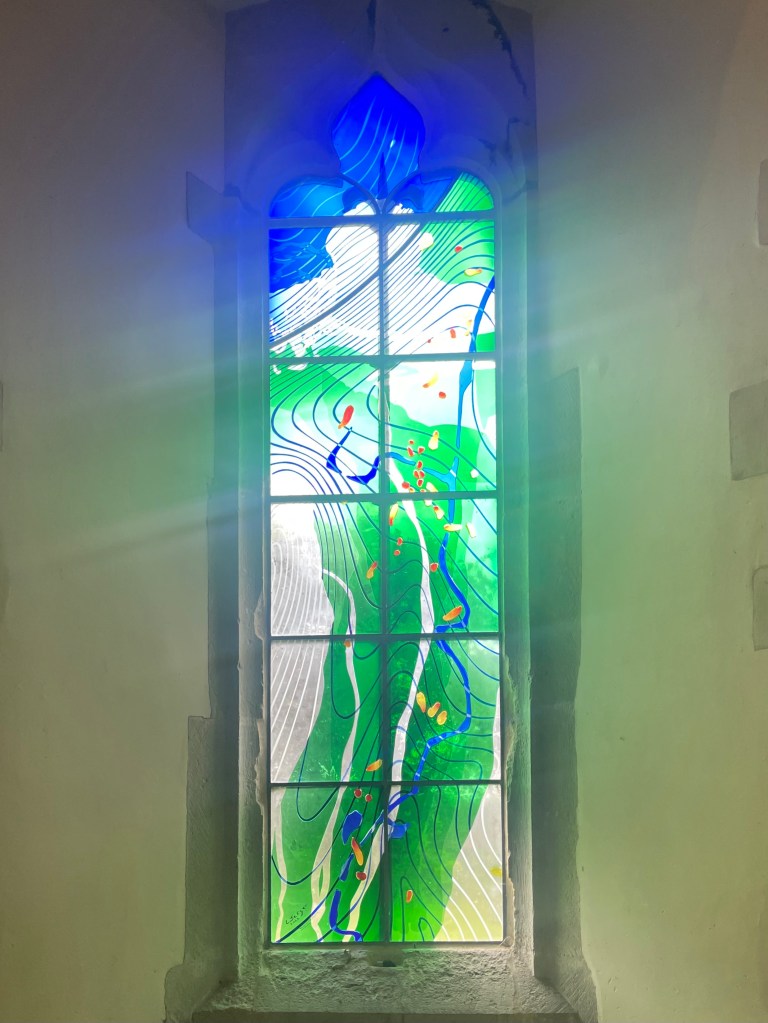
If you are interested in this way of working and would like to attend an event, I have a one-day retreat coming up later in the summer, which is being held at a gorgeous yurt in the East Sussex countryside. There will be an optional 10-12 mile walk the next day (there are a couple of possible shortcuts) walking the Cuckmere Pilgrim Path. The photograph on this post comes from a stained glass window at the Selmeston Church, which is one of the seven ancient, rural churches along this pilgrimage. We will be stopping at all seven of the churches, which offer beautiful spaces for contemplation and spiritual nourishment, of course, as well as time for a picnic lunch. This is a very special offering for a small group, so do get in touch soon if you’d be interested in hearing more.
hello@frayazellawolf.com
 Dr Fraya Zella Wolf
Leave a comment