
Photo by Jason Leung on Unsplash
More than twenty years ago, during my training, I was introduced to Kolb’s experiential learning cycle, and I have returned to it many times since then, both in my own reflective practice and in my work with clients.
It is a simple model, but a profound one. Kolb first set out the model in Experiential Learning in 1984, and it stands the test of time. At its heart is the recognition that experience alone does not necessarily lead to learning.
We can go through something difficult, moving, illuminating or even life-changing, yet fail to absorb what it has shown us. We may understand something briefly, only to return to an old pattern. We may have a powerful insight during therapy, coaching, meditation or retreat, but lose contact with it as soon as we re-enter the pace and demands of ordinary life.
For experience to become wisdom, it needs to be reflected upon, understood and carried forward into the way we live. This is called integration, and is often a missing piece of many of today’s offerings in the wellness industry such as workshops and retreats. Yet, reflection is an important part of healing, because we risk not learning from our experiences without it.
Experience is only the beginning
David Kolb developed his experiential learning model to explain how we learn through experience. The cycle contains four interconnected stages:
- Concrete experience
- Reflective observation
- Abstract conceptualisation
- Active experimentation
Although these terms may sound academic, they describe a process many of us move through naturally.
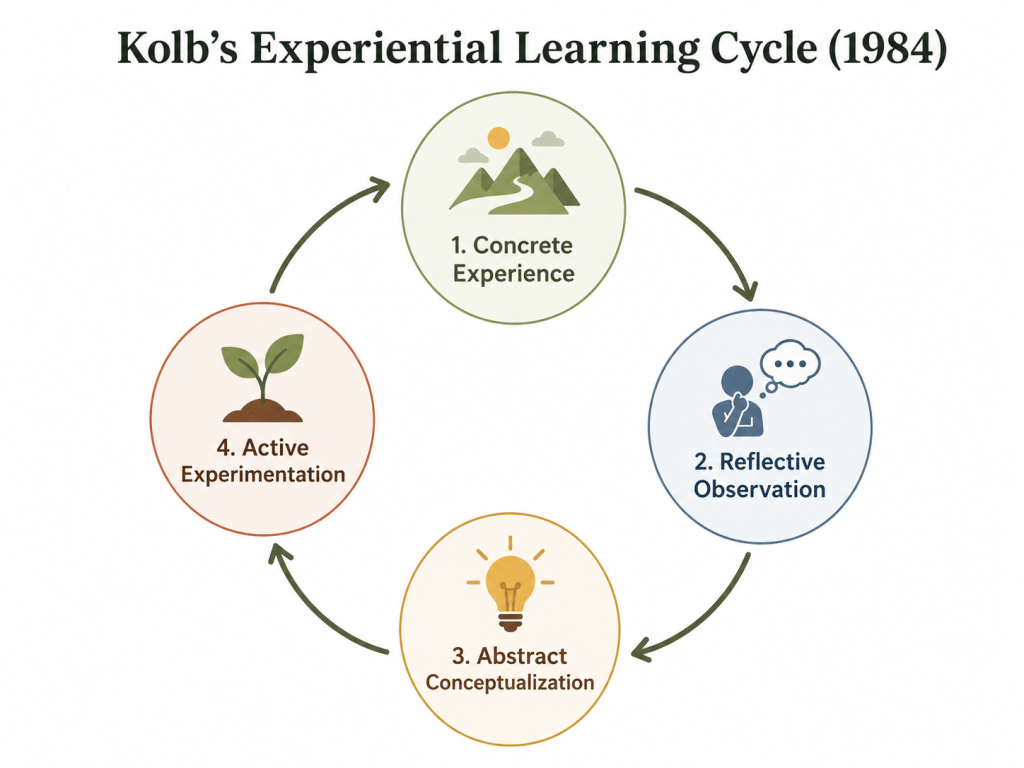
Something happens. We pause and look back at it. We begin to understand what it means. Then we allow what we have learned to influence what we do next.
The process continues as each new action creates another experience from which we can learn.
1. Concrete experience: What happened?
The cycle begins with an experience.
This might be an argument with a partner, a difficult interaction with a client, a moment of emotional overwhelm, an unexpected boundary, a powerful conversation, a bodily response or a sudden sense of clarity.
It may also be a quieter experience: noticing that we felt safe enough to speak honestly, that we remained present during a difficult moment, or that something which once triggered us no longer carried the same emotional charge.
Healing takes place through lived experience. We encounter the world, other people and ourselves. We notice what opens us, what frightens us, what overwhelms us and what brings us home.
But when we move too quickly from one experience to the next, we may miss what the experience was trying to show us.
2. Reflective observation: What did I notice?
The second stage asks us to pause.
What actually happened?
What did I feel?
What happened in my body?
What story did I begin telling myself?
What did I need but struggle to express?
What surprised me?
Reflection allows us to revisit an experience with curiosity rather than immediately categorising it as a success or failure.
This distinction matters. Reflection is not the same as self-criticism, overthinking or repeatedly analysing what went wrong. Rumination often traps us inside the experience. Reflection gives us enough space to see it more clearly.
For many people, that space becomes possible only when the nervous system has settled.
When we are still highly activated, our reflections may be shaped by fear, shame, blame or the need to protect ourselves. Sometimes the first step is not to understand the experience but to regulate ourselves sufficiently to meet it.
We may need to walk, breathe, rest, cry, write, sit in nature, speak to someone safe or simply allow time to pass.
Reflection cannot always be rushed.
3. Abstract conceptualisation: What am I learning?
As we reflect, meaning begins to emerge.
We may recognise a repeating pattern. We may connect the present experience with something from our history. We may realise that a reaction we had judged harshly was an attempt to protect us. We may see that what appeared to be anger was fear, or that what looked like withdrawal was overwhelm.
This is the stage at which we begin forming a new understanding.
Perhaps I notice that I become defensive when I believe I am being criticised.
Perhaps I realise that I abandon my own needs when I am frightened of losing connection.
Perhaps I understand that I have been interpreting another person’s silence through the lens of an earlier relationship.
Perhaps I recognise that I need more rest, support or preparation before offering so much of myself to others.
For practitioners and healers, this stage is especially important. Our work continually brings us into contact with human vulnerability, trauma, hope, projection, intimacy and change. We are affected by what we witness and by the relationships we form.
Without reflection, we can carry experiences forward without knowing what we are carrying.
Reflective practice helps us distinguish between what belongs to us, what belongs to another person and what may be arising in the space between us. It allows our work to deepen without requiring us to pretend that we are untouched by it.
4. Active experimentation: What will I do differently?
Insight becomes transformative when it begins to shape our choices.
The final stage of Kolb’s cycle asks how we will apply what we have learned.
What might I try next time?
What conversation do I need to have?
What boundary might protect my energy?
What support do I need?
How might I respond differently when this pattern appears again?
The change does not have to be dramatic. Often the next step is very small.
It might be taking one breath before replying.
Asking for time rather than disappearing.
Naming a feeling rather than acting it out.
Resting before exhaustion becomes collapse.
Checking an assumption rather than treating it as fact.
The next time we meet a similar situation, we bring this new possibility with us. Our response creates a new experience, which gives us something further to reflect upon.
This is how learning becomes a living cycle.
Healing as a sacred path
I’ve long thought of healing as a path and a journey. I’ve met people who do not like these terms, but for me, this is what my life has been about., and I know that, generally, this is true for wounded healers.
More recently, I’ve been writing about two more paths: The Pilgrim Path, and Relationship as the Path. The latter term here is a concept that I am using in a book that I am writing for couples, and the former is related to a nervous system reset day that I am offering in September, which has an optional walk on the second day.
Reflecting on how I am using the path as a metaphor so often, makes me realise that it speaks to me about healing as a sacred quest.
It is not always only about recovering from what has happened to us, changing an unhelpful pattern or learning to function more effectively. Oftentimes, healing draws us into questions of deeper meaning, life purpose, and soul awakening. It asks not only, How can I feel better? but also, What is this experience asking me to understand? Who am I becoming through it?
Relationship can be part of this sacred path. Intimate partnership has a way of bringing us into contact with our deepest wounds, protections and longings. Some relationships carry what feels like a karmic quality: a sense that something larger is being worked through, revealed or transformed between two people.
This does not mean that every painful relationship should be endured, or that suffering must be spiritualised. Nor does it mean that every experience has a simple lesson waiting to be found. But for many of us, relationship becomes one of the places where our inner life is most profoundly exposed.
We meet the parts of ourselves that long to love and be loved. We encounter the fears that make love difficult to receive. We discover where we abandon ourselves, where we protect ourselves and where we are being invited into greater presence.
This is what I mean by relationship as the path.
The path is not necessarily linear, and the two people may not travel at the same pace. Sometimes one person begins healing, questioning or awakening before the other. Sometimes the relationship grows with them. Sometimes it cannot. Yet even then, the experience may become part of a larger unfolding.
Reflection allows us to listen for that deeper movement. It helps us ask not only what happened and what we will do differently, but what the experience may be revealing about the life we are being called to live.
In that sense, we become pilgrims: not people who already know the destination, but people willing to travel with attention, reverence and an openness to being changed by the path.
A pilgrim is not simply trying to reach a destination as quickly as possible. The path itself matters. There are periods of movement and periods of rest. There are thresholds, detours, encounters and unexpected revelations. There are times when the way ahead becomes clear and times when we must stop and listen.
Sometimes we need to look back before we can understand how far we have travelled.
Reflection is one of the places where experience becomes part of the journey rather than something that merely happened to us.
It helps us gather the fragments.
It allows us to recognise the meaning of what we have lived through.
It shows us where we are repeating an old path and where something new is beginning.
The cycle may be drawn as a circle, but lived experience often feels more like a spiral. We return to familiar themes, relationships and wounds, but we do not necessarily meet them from exactly the same place. Each encounter offers the possibility of a little more awareness, choice and compassion.
We may still be triggered, but recognise the trigger sooner.
We may still withdraw, but find our way back more quickly.
We may still feel afraid, but remain connected to ourselves while the fear passes through us.
Healing is not always the disappearance of the pattern. Sometimes it is the growth of our capacity to meet the pattern differently.
Why healers need reflective space
Many of the people I work with are themselves therapists, coaches, healers, facilitators or practitioners of some kind. They spend much of their lives creating space for other people.
Yet those who hold others also need places in which they do not have to hold everything together.
We need time to integrate what we are experiencing, both professionally and personally. We need room to notice where our work is nourishing us, where it is depleting us and what our own bodies and lives may be asking from us.
The wounded healer is not someone who must become perfectly healed before offering anything to others. Our own wounds may be part of what allows us to recognise and accompany suffering with tenderness.
But our wounds also require our attention.
Reflection helps prevent our lived experience from remaining unconscious. It allows our vulnerability to become a source of awareness rather than something we unknowingly carry into every relationship and every room.
A simple reflection practice
You can use Kolb’s cycle to reflect on almost any meaningful experience.
Choose something that happened recently and give yourself time to consider four questions:
What happened?
Describe the experience as simply and honestly as you can.
What did I notice?
Include your emotions, bodily sensations, thoughts, needs and responses.
What am I learning?
Look for patterns, meanings, connections or a new understanding.
What might I try next?
Choose one small action, experiment, boundary or response to carry forward.
You do not need to find a perfect answer. The purpose is not to solve yourself, but to enter into a more conscious relationship with your experience.
Making space to hear ourselves
We live in a culture that encourages us to keep moving.
Even healing can become another form of striving: another book, course, practice, modality or breakthrough to pursue.
But healing also requires pauses.
There are times when we do not need another answer. We need enough quiet to hear what our existing experiences have already taught us.
This is part of the intention behind my Nervous System Reset Day/Weekend: creating time to step away from ordinary demands, settle the nervous system, reflect and listen for what may be trying to emerge.
It is an invitation to pause on your path.
To look back with compassion.
To notice where you are now.
And to take your next step with greater awareness.
hello@frayazellawolf.com
 Dr Fraya Zella Wolf
Leave a comment